A Note to Boys Who Dance and to Their Parents

I have been reading a lot lately about boys abandoning their dance training because of social pressures. Their teachers are desperately trying to keep them in the studio…but to no avail. This note is meant for those boys, wherever and whoever they may be.

I was a child who was bullied. I was relentlessly teased and picked on for most of my childhood; and that became a way of life for me. When I was growing up we were told “grow a thicker skin”, “don’t listen to them”, “stop being such a baby”. This was not a time where schools tried to stop bullying. This was not a time when parents or teachers intervened. Those of us who were marked as victims simply dealt with it. And it wasn’t easy.

I was also a child who loved dance. From the first Nutcracker that I saw on television at the age of 5, I was obsessed. I KNEW that this was what I was meant to do. There was no question. My sister was given dance classes. The neighbor girls were given dance classes. I was not. As far as my parents were concerned “boys didn’t dance”. And being that I was always an excellent student, they felt that any career in the arts would simply be a waste. I was in school plays where I would sing and dance. I was in summer camp productions where I would sing and dance. But that was purely recreational and there was no actual training involved.

There was a very careful and deep manipulation that occurred in my family. I was programmed to get good grades, go to college, find a career and make money. And for some reason, as ridiculous as this sounds, I believed that if I didn’t follow this path, if I disappointed them by not following this path, my family would stop loving me. Looking back at it now, I’m sure that wasn’t true; but that’s what I believed.

So I took my first dance class as an adult, when I could finally afford to pay for it myself. And I was “home”. And I would venture to guess that there was never a more serious adult beginner. I arranged my life and my work schedule so that I could study. I found the best teachers in New York…and they were willing to take me on, and take me seriously. I rented a bedroom in someone’s apartment rather than pay actual rent, so that I could afford to pay for all my classes. And I worked harder than I ever thought possible. And I started getting work; not major dance companies, not Broadway, but actual work- off Broadway, regional musical theater, smaller dance companies, music videos, television commercials, etc.. And setting my sights on the Broadway stage or a major dance company I trained even harder and I auditioned for everything. And when I couldn’t achieve those goals, I “retired”. And I will never know what might have been if I had been given the opportunity to train when I was young. And it has haunted me for the rest of my life.

I am now a dance teacher. I started this new career much later than most teachers . And I have worked very hard to make this new career my life. And I now teach in New York City at the Joffrey Ballet School and Broadway Dance Center among other schools. And I travel the world as a guest teacher. And I couldn’t be happier. I do believe that I am the teacher that I am because I started so late. I believe I have a unique perspective on how to make a dancer because I fully remember what it was like to know nothing. But I still look back at my past with regrets, and I wonder…

One of the most wonderful things about children and adolescents is that they live “in the moment”. One of the most tragic things about children and adolescents is that they live “in the moment”. If your passion is dance, if your calling is dance, if your life is dance then some very important decisions need to be made at a very young age. Everyone wants to fit in. Everyone wants to belong. And no one wants to be picked on, bullied or teased because he dances. But I would have happily endured the bullying and teasing if it meant that I had the opportunity to study and to train to be a dancer (I was already enduring it anyway). It is so hard at a young age to look into the future. But please, I implore you, do not go down my path. When I started teaching, I confronted my mother. I told her that I felt that I was manipulated into a career path that I wanted no part of. My mother’s response: “Well you should have been stronger”. And she was right.

So to my “brothers” and “sons”; to all boys who dance. Please learn from my mistakes. Please be strong. You only get one lifetime. You only get one chance to be young. You only get one chance to train for a life as a dancer; and if your parents support your dream you are very lucky. But even if your family is not fully behind you; be tough, be strong and follow YOUR path. Because the pain of the teasing and bulling; the pain of parental disapproval is nothing compared to the pain of wondering what might have been. And I know that first hand. So DANCE.
Why I Still Take Class

As often as I can, I start my day by taking ballet class, bright and early, 10:00 AM. I still take class whenever possible. Clearly, at my age, my performing career (save an occasional Drosselmeyer) is over, but the ritual of taking ballet class has stayed with me.

For hundreds of years, dancers have begun their day with ballet class; walking into the studio and placing their left hand on the barre. Every time I enter the studio, and grasp that barre I feel a connection; both to all the beautiful dancers that came before me and all the dancers that will help guide into the future of our art form. That simple gesture of taking the barre centers me, focuses me and brings me peace. Ballet class has been a constant throughout my life just as it has been a constant throughout the history of western dance. But it is not just the ritual that draws me to the studio. I take class to be a better teacher.

I often say that the study of ballet is the relentless pursuit of an unachievable perfection. And so every day I continue that pursuit. I want to continue to experience what my students are experiencing. I want to continue to work, to study, to improve (yes, some things still improve). And I want to use the improvements I make, the things that I find, to help my students. But with the passing decades there has also been a decline as my body ages. So I continue to work and to study with this aging, declining instrument, and that challenge has allowed me to make new discoveries…discoveries that enrich my work in the classroom every day.

I have written many times of my mentor, Luigi. When he taught his Jazz Technique, he demonstrated everything, full out, very slowly, while describing both what he was DOING, as well as what he was FEELING. He asked the students to perform the exercises with him, full out, during the demonstration, guiding them through the technique exercises and helping them to find those feelings. He oftentimes said “Feel first, then do”. He also said “if it doesn’t feel right, I don’t teach it”. I remember him making discoveries and how thrilling that was for him. He would say “I,wish you could feel what this feels like”. His method was not about “put your foot here” or “put your arm in this position” or “keep your shoulders down”. It was so much deeper than that. And the result that he got from his students was astounding. And so I strive to bring to my BALLET students what he brought to me. I want to pass on his concepts of how the body works; how to develop a beautiful quality of movement, a long beautiful line that goes on for ever, a deep sense of musicality, an expressive epaulment that is so much more than shoulder and head positions, a sense of connection both within the body and to the space around us. And since the structure of a ballet class makes it difficult to dance full out with the students, I need to do this deep and personal work and make these discoveries for myself, while I am studying.

I will never be a teacher who parrots back what I was taught. I have been fortunate that I have been taught by the very best ballet teachers in New York City. And so I have taken their teachings and made them part of my consciousness and part of my body. To this I have added the experiences that I have had on the stage. And all of that work and information is carried into the studio with me as I continue to study, to look for new feelings, new ways to achieve a line, or refine the execution of a step, or find a richer and deeper sense of musicality and phrasing, or reach out and touch my audience. I do not want to teach in a museum. I want my classroom to live, breathe, grow and vibrate with excitement. And this is the only way I know how to achieve that.

So this morning, at 10:00 AM I walked into the studio to take Michelle Cave’s beautiful open class at Steps on Broadway. I placed my hand on the barre. I felt the connection to the past and to the future. I felt focused and at peace. I was ready to dig deep and to work…looking for something new. And to my astonishment, standing with me at that barre was one of MY teachers, and one of my STUDENTS. And the chain continues.

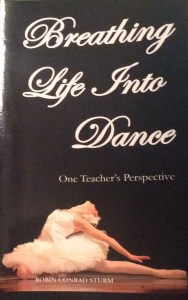
Breathing Life Into Dance, One Teacher’s Perspective – A Book Review

In her beautiful book, Breathing Life Into Dance, Robin Conrad Sturm does just that. I have been familiar with Ms. Sturm’s writing for some time now, having read many of her inspirational, charming, thought-provoking and always enlightening blog posts. But those posts could never have prepared me for what lies within the pages of this book. Part autobiography, part teaching manual, part survival guide and part blog, this book touches on every aspect of building a dancer and a life in ballet. Her passion and her love for this art-form, for a life spent studying, exploring and celebrating ballet infuses every page with that life.

This book chronicles every aspect of ballet education: technique, artistry, syllabi, pointe work, adult beginners, choreography, performances and auditioning. She talks about the transition that every dancer must make when a performing career comes to an end. She discusses teaching. She writes about the college decision many dancers face when high school ends. And she graces us with a number of her beautiful articles and musings on ballet and ballet education.

But what sets this book apart from the myriad of teaching manuals and ballet survival guides that I have read is its focus. This book is centered on the love and the joy and the LIFE found in the process of studying ballet. It should be read by every dancer, every teacher, everyone who loves this art form. I smiled from cover to cover.

Breathing Life Into  Dance is published by GraceNotes Press

More Thoughts on Competitons

I spend quite a bit of time online, reading various threads and posts about dance; both teaching and performing. There is a theme that keeps coming up over and over again in posts from teachers working in the competition setting and it has spurred me to write this article.

As a preface, I would like to say that I think that dance competitions have a lot to offer. I think that they teach young people about team work, about commitment, about goals. Competitions teach kids to be good losers as well as gracious winners (hopefully). And competitions help instill a good solid work ethic in our dancers, something that sadly seems to be disappearing with each successive generation. I should also say that I am not directly connected to the world of competition dance. The majority of my regular teaching is in the pre-professional/conservatory and professional setting (Joffrey, Broadway Dance Center, NY Film Academy, CAP21, Marymount Manhattan College, Molloy College). I’ve never competed myself. I’ve never choreographed specifically for a dance competition. And the last competition that I judged was in 1990 (competitions were very different then). I do, however, travel the country extensively as a guest teacher for numerous competition studios that are looking to bring something different/unique to the way their dancers work. So,that being said…I am offering my OPINION as a dance educator and choreographer; as someone who has spent his entire life bucking convention, and not as an expert in competition dance.

The posts to which I am referring usually begin something like this:

“How do judges feel about…”

And the question is usually about something like: dancing with no tights, inserting various tricks into a piece of choreography of particular genre, wearing a particular kind of costume, using a particular type of music or editing music in a particular way, and the ever popular “dancing with one shoe”.

And so I read these questions and I read the answers. And sometimes I have an opinion and sometimes I don’t. And sometimes I sit back and follow the thread and sometimes I contribute. But there is a question that is always in the back of my mind:

“What are you trying to present on that stage? Why are you competing? What is the goal?”

I would hope that what the teacher and what the dancers are trying to present on that stage is a piece of art with a vision. I would think that a choreographer would want to take those few minutes of stage time to present a piece of choreography that they were INSPIRED to create. Perhaps there was a piece of music that spoke to the choreographer and so the piece was created to bring that music to life in a new way. Perhaps there is a story to tell. Perhaps there is a mood to be set. Perhaps the piece is a commentary on something deeply important to its creator…the reasons for, and purposes of art are LIMITLESS. And, in my opinion, the choreography, the music, the costumes, should all serve the vision. I have written extensively about the use of tricks in choreography; so to be brief here, tricks can be fantastically exciting and thrilling but they should, in my opinion, serve the vision. Tricks can enhance the piece in a very profound way, if they are used to highlight a point in your story-telling, or to underline a moment in the music or to express an emotion or mood. But when tricks are used to demonstrate that a group of dancers can cleanly (or not so cleanly) execute a complicated series of turns or jumps- then that trick, which could have been used to create a moment of excitement- has devolved into a vulgar display of technical prowess with no meaning or connection to the work.

I would think that once this piece of choreography has been created, taught and polished, it would then be presented for the judges approval. In this way our dancers are learning about the creative process. They are learning how a choreographer takes music, costumes, dancers and the limitless powers of their imagination and creates something truly wonderful. They are learning how art is made. They become part of our tradition, our history of dance. And as dancers have done, since the beginning of the art-form, they PERFORM the piece. And then they will be judged. And perhaps the judges will love the piece. And perhaps they won’t. And maybe they will win, and maybe they won’t. But I would think that our GOAL should be to teach our dancers about the creative process and about the making of art.

If we set out from the start to cobble together a piece that is CALCULATED to win, where is the value in the lesson that we are teaching our students? What is the real value in that trophy? But if we have a vision, and if we, with the greatest of integrity, bring that vision to the stage, I would hope that the judges would see that vision, that honesty, that integrity, and reward it. But if they don’t, perhaps there is something to be learned there as well.

So if your artistic vision includes dancing with one shoe (and perhaps there is brilliant way to create a piece about a dancer who looses a shoe) I say Bravo! But let’s try to use the competition stage to continue to educate our dancers and prepare them for their futures. Trophies can be bought, but a lifetime spent in artistic pursuit is truly a gift.

Teaching and Cultivating Musicality

I have continued to take classes throughout my entire career and I have written extensively about why I am still taking class. One of the things that I have noticed about the open classes that I take New York City is that, for most ballet teachers and most ballet dancers, there seems to be a loosey-goosey approach to rhythm and musicality.

Combinations presented in most ballet classes tend to be rhythmically very straightforward: “a-1 and a-2 and a-3 and a-4, a-5 and a-6 and a-7 and a-8″. And even given the simplicity of the choreographic rhythm, the dancers seem to be completely oblivious to the music which is filling the space around them. I remember seeing a beautiful dancer, en pointe, float an absolutely exquisite pique arabesque…that went on FOREVER; as if the music wasn’t even there. She then, after finally rolling down, sped through the next phrase of music in a sloppy, hap-hazard fashion to try to,”catch up”. Similarly, I saw a dancer in class who is in the corps of ABT toss off five pirouettes, neat as a pin. There was barely enough time to accomplish two turns; leaving him hopelessly behind the phrase and again, sloppily rushing through the rest of the choreography.

And the teachers say nothing.

Nobody understands the economic difficulties surrounding teaching open classes in New York City better than I. There are many dancers who do not want to be corrected; and many of them will not come back to class if they have been singled out. But without singling out dancers, if ballet is going to continue as a vibrant, evolving, growing art form, we must start teaching and cultivating musicality. Otherwise I fear that our great and beautiful art form will devolve into a vulgar athletic display.

Firstly, I believe that we should be choreographing ballet combinations that have interesting, more complicated, and even syncopated rhythms. (I believe this is even more important for jazz, where I see most classroom choreography constructed squarely “on the beat” with one step or movement for each count.) Dancers need to understand music. And if our work is going to be interesting, intriguing and engaging, then our choreography should be musically complex. This is essential, both for the training of the dancers as well as generating new and interesting choreographic ideas. And this rhythmic complexity should not mirror exactly what is going on in the rhythm of the music. Rather, the choreography should have its own unique rhythmic voice that fits into the fabric of the orchestration/arrangement of the music.

I have always tried to construct my choreography in this way. And I do not ask my students to dance to the music. I do not ask my students to dance on the music. Rather, I implore my students to dance inside the music. I tell them: “Let the music fill your body. Let the sound guide what you do. Feel the music and the choreography from INSIDE your body. Take the complex rhythms that I have given you and fit them into the fabric of the music. Don’t dance the steps, dance the SOUND and make the dance and the music “one”.

I have found that with this approach, dancers are less likely to show off with multiple pirouettes or endless balances. They are too busy concentrating. They are too busy feeling. They are too busy connecting with the music. And when they are feeling what they are doing in a very profound and honest way; when they are fully concentrated, and completely connected to the music, and the choreography, and the space around them…THEN they begin to have the tools they need to truly reach out and touch an audience. I don’t want to train dancers that can impress and audience. I want to train dancers that can move an audience. Another relentless pursuit of an unachievable perfection.

There Is More Than One Way To Make A Dancer

I recently read a thread of posts on the Internet in which Jazz teachers were talking about teaching “progressions across the floor”. Many teachers participated in the discussion as they all extolled the merits of structuring their classes in this way; insisting that teachers who did not subscribe to this method of training “were not good teachers”. As I read this thread I started reflecting on my training as a student and the changes that I have made in my opinions, in my dancing and in my teaching over the last decade.

I did the majority of my serious preprofessional training under the tutelage of very few teachers. I studied ballet primarily with Madame Gabriella Darvash and Jazz with Luigi. Of course I took classes with other teachers, but for the most part, they were responsible for my training. These teachers were hugely famous and important in New York (and around the world) at that time. I had limitless respect for them and I deeply and truly believed that what they taught was RIGHT. They were famous. They were respected. Their students were some of the most brilliant dancers ever to step onto a stage. Their way HAD TO BE the RIGHT way. I continued training under these teachers for my entire career; but for numerous reasons I retired from performing relatively young and I left the dance world completely. Nine years later I resumed taking classes and found that the big studios like Steps on Broadway and Broadway Dance Center had undergone a significant change: When I was a student, Madame Darvash taught 4 to 5 classes a day, every day. Luigi (or an assistant teaching his technique) taught 6 classes a day. This kind of scheduling no longer existed. Teachers were teaching pretty much once a day… And many weren’t teaching every day. So in order to cobble together a schedule of classes that fit into my life, I was going to have to take classes with various teachers. And this change opened my eyes in a way that I would never have expected.

As it turns out, what Madame Darvash taught and what Luigi taught was drastically different than what many other teachers were teaching. But I KNEW that I had been taught by the BEST. So I went into these new classes with these new teachers and stubbornly worked the way I had been trained. I also started teaching and I parroted to my students exactly what I had been taught by my two mentors.

Well I was clearly no longer going to have any kind of serious performing career, but some of these new teachers took and interest in me anyway and started correcting me. I realized that if I was going to be in their classroom, if I was going to take their classes I should work in a way that was consistent with their teaching. I also became friends with some of these teachers and had some truly remarkable discussions and exchanges of ideas. And this is where my dance education really started to expand.

It seems that Madame Darvash’s ideas on placement and technique ran contrary to what many teachers were teaching. As I started to work with disciples of Maggie Black I realized that there was a completely different way to look at ballet placement and technique. Many of my readers might be shocked to hear that Madame Darvash taught that the hips should NOT be level during Passé. She also taught that “side means side” (even if you have to turn in a bit to get there). And her reasons for these sorts of ideas were definitely valid. But as I continued to study ballet technique and placement with various teachers such as David Howard, Fabrice Herrault, Lisa Lockwood and Elena Kunikova I started to realize that if I was going to be effective as a teacher I was going to have to open my eyes and my mind. What Madame Darvash taught worked. She trained very successful dancers. Her students were principal dancers in great companies. But now I have come to realize that her way is not the ONLY right way. And so I began looking at what many other “great” teachers were teaching. I took as many classes as I could. I watched the results that they got. I felt how their teachings worked on my body. I discovered what worked for me and what didn’t. And as I continued to teach I felt a change take place in MY classroom. I started formulating MY approach to ballet technique class. I started to command the classroom in a way that I never had before; and in response, I could feel a change come over my students as well.

Keeping our minds open to new and different ideas is the key to our growth as educators. It took me many years to realize this; but once I did, it paved the way for the next exciting chapter in my career. And isn’t this what we all want: to keep growing as artists and as teachers? If our classrooms are going to be vibrant, exciting, innovative places to cultivate artists we must be open to new and varied approaches and never reject new or different philosophies out of hand. We never can tell what we might learn.

With respect to the thread on teaching progressions across the floor: Luigi pretty much invented the concept of the Jazz Class. His was the first codified training method for the teaching of Jazz. His students, Like Madame Darvash’s were unique, exquisite, exciting artists in major companies and Broadway musicals. He trained many STARS including Ben Vereen, Donna McKechnie, Alvin Ailey and Charlotte D’Amboise. And he never taught progressions across the floor. I studied with him for nearly 30 years and not once did we do progressions across the floor. His technique exercises (he never used the term “warm up”) were designed to teach TECHNIQUE not merely get the dancers warm. His combinations were choreographed to be both works of art as well as important training tools; making dancers who were both expressive artists and technical powerhouses. Do I think that progressions across the floor are valuable and important? Of course I do. But if we keep our minds and eyes open we can learn that there are many different ways to get a result.

I recently started taking ballet classes with Zvi Gotheiner. And once again I am examining yet another way to look at training dancers. I am not sure I agree with his approach. But I am learning something new. And perhaps his work will inform my teaching and perhaps it won’t. Just as the teachers who take my classes may bring my ideas into their classrooms. This is how our profession blossoms. My time in Mr. Gotheiner’s class is making me think, analyze, explore and examine new ideas. And what could be more thrilling?

Opening Doors – My Students Perform Merrily We Roll Along

So last night I attended Merrily We Roll Along at NYFA. I have a strange relationship with this show and I found the evening to be surprisingly and overwhelmingly emotional. As I followed the characters in this show back through their past and watched the repercussions of the decisions they made, I found myself examining my past, my decisions, my life.

My blog posts are typically about the teaching of dance; this one will be different.

For those of you who are unfamiliar with the show, Merrily… follows the lives of its three main characters, Frank, Charlie and Mary, backwards through time, and the resulting story is both heartbreaking and tragic. But the heartbreak, because of the timeline of the show, sneaks up on you in a way that is totally unexpected. When the show opens we find the three characters angry, unhappy, vicious and no longer friends. We know the ending right from the start; we know that their story doesn’t end well. But as the play unfolds, and we travel back through time with them, we watch them get gradually younger, more idealistic, more optimistic until ultimately, in the show’s final scene we find Frank and Charlie on a rooftop in New York where they meet Mary. They are all in college. They are all fresh and innocent. They are all looking toward their future with wide-eyed anticipation and excitement. They are ready to conquer the world. And seeing them like this, while knowing how they will end up, made my soul ache in a way that I found very surprising.

This is not the first time that I’ve seen this show, but this is the first time that I had a reaction this strong. Frank, Charlie and Mary end up the way they do because of decisions that they made. And there I sat, reliving the last thirty years of my life, reflecting on the decisions I made and how they guided my path.

My first paid dancing job was in a regional production of A Chorus Line. In that cast I made two very close friends. It’s ironic in that we were very much like Frank, Charlie and Mary at the end of Merrily; young, happy and inseparable….. and like Frank, Charlie and Mary at the top of the show (the end of their story); we are no longer friends. When A Chorus Line closed, the three of us created a revue that we performed around town (like the three characters in Merrily…) and it was one of the happiest times in my life (again, like those three characters). But then life throws roadblocks at us, and we need to make decisions; and those decisions affect our lives in ways we could never imagine. I made some decisions that I deeply regretted for many years. I was quite adept at blaming my family, blaming my friends, blaming my support system for the decisions and the mistakes that I made.

When I reached my late forties I found myself disillusioned, unhappy, and estranged from those friends that I so treasured in my youth. When I was about to turn fifty I took my first step to turning my life around: I had made some really bad decisions. And rather than continue being angry I made the DECISION to FIX the situation. I decided to apply for a job teaching ballet at a small neighborhood dance school. And all of a sudden this teaching career happened. And doors started opening. And I found myself teaching at CAP21, NYFA, Molloy College, Hunter College, Marymount Manhattan College, Joffrey Ballet School and Broadway Dance Center. And now I have made another decision (that I’m not quite ready to discuss) to keep me “Rolling Along” in my teaching career; the career that wasn’t supposed to happen; the career that shouldn’t have been possible. But I am determined NOT to end up like Frank, Charlie and Mary. We all know that this business is brutal and that the competition is fierce. But the three hours spent in the theater reminded me how important each decision can be; and I hope that I can remind my colleagues and students to carefully weigh each decision at each crossroad. And when we make the wrong decision – as we all inevitably do at some point in our lives – I hope that I can encourage these decision-makers to resist the temptation to just sit back. Try not to remain defeated and angry, glaring with disdain both toward the past and the future. I am now, at my age, looking at my future with “wide-eyed” anticipation as I am currently discussing future guest teaching engagements in Russia, England, Ireland and Switzerland. And who knows, perhaps I may someday reunite with those treasured cast-mates that I have lost. To borrow a lyric from Merrily… “I’m opening doors”.

A Passion For The Work

I don’t usually quote other writers, with long excerpts but I found an interview that really caught my attention. The interview was with the author Robert Greene about his book Mastery. In this book, the author discusses what the secrets are to mastering a skill and his belief that passion can turn into expertise.

The interviewer, Dan Schawbel of Forbes, poses the following question:

“Do you believe that passion can turn into expertise? A lot of people are saying that you shouldn’t follow your passion anymore. What do you think of that?

“Not only do I believe passion can turn into expertise, or mastery (I prefer that term), I believe it is absolutely essential. To not follow your passion in life is a recipe for failure and unhappiness. Most often people choose career paths that diverge from what really interests them because of pressure from parents and peers, or motivated by the desire for money. What ends up happening is that in our twenties and maybe even in our thirties, we can do pretty well in our work, even though it is not a passionate interest. We are young and have energy; we get satisfaction mostly outside work. But it then eventually our lack of deep connection to the field catches up with us, often in our forties.

“We feel increasingly disengaged and not challenged. Our natural creative energies have gone fallow. We fail to pay attention to the changes going on in our field because we are disconnected. People younger, more creative and less expensive quickly replace us. We find that we cannot shift or adapt because we have not build up the proper learning skills with the requisite patience. It is funny, but the people in life who are primarily motivated by money or security often end up losing whatever they gain, where as those who follow their passion end up making more money than they ever desired.

“To really become an expert or master requires the infamous 10,000 hours, or even 20,000 hours – perhaps the difference between being a chess master and a grandmaster. To apply yourself to a field or to a problem for that long a time means there will inevitably be moments of boredom and tedium. Practice, particularly in the beginning, is never exciting. To persist pass these moments you have to feel love for the field, you have to feel passionately excited by the prospect of discovering or inventing something new. Otherwise, you will give up… If you are excited and obsessive in the hunt, it shows in the details. If it comes from a place deep within, the authenticity of the task will be communicated…There is no mastery or power without passion. Through all of my research, that I much I am certain about.”

I have written extensively on the “process” of studying ballet; and on finding joy in that process. I have been watching my students closely, for a number of years. I watch them from the moment I walk into the classroom (most students don’t seem to realize that teachers and choreographers are watching them when they AREN’T dancing as well- and that this can tell us a lot). What I see, as students wait for class to begin, is that the majority of them are engaged and focused somewhere outside the realm of ballet class. They are very often focused on their phone, or chatting with their friends, or rummaging through their bags. I see fewer and fewer students using that precious time to engage in a “pre-class ritual” of warming up, or checking positions and alignment in the mirror; preparing mentally and physically for the highly intense and complex task of building and honing a classical technique. And that speaks volumes. In fact, I was discussing this very point this morning with a colleague. I asked her:

“What do our students lack that made me spend hours in the mirror at home, often till 2:00 AM, trying to get a line just right: examining my arabesque, adjusting my arms, adjusting my foot, adjusting my head, looking for just the right feeling to breathe life into the position- never being quite satisfied?”

Her response – which was unprompted by me:

“The same thing that caused me to fall asleep, stretching in second position until my mother came in, woke me up and forced me to go to bed…PASSION.”

Each student sets out down the road of pre-professional ballet training for their own reasons. But, as Robert Green discussed in this interview, a lack of passion is a recipe for failure. I think many students are enamored with the IDEA of being a ballet dancer. I think many are drawn to ballet out of a desire to be in the limelight. I think some are drawn to the glamour of the stage. And sadly, there are still students who are the products of over-ambitious stage-mothers/fathers. But what I see missing so often is the one key element to success: a passion for the WORK. I know a lovely ballet dancer in her twenties. I see her in open classes in New York City quite often. She has been blessed with excellent equipment and she has a well put together, professional level technique. As a dancer she is perfectly fine. But we all know that “perfectly fine” is no longer good enough to secure a contract. Last week she was standing next to me at the barre and she said to me; “It is so hard for me to get out of the apartment and get to class every day…but I know I HAVE TO do it.” And right there is the reason why she is “perfectly fine” and has no career. The lack of passion. Still, after all these years, long after my performing career ended, I can’t wait to get to class; I can’t wait to work on the fine tuning of what is left of my technique; I can’t wait to discover something new…Because I was the person who initially followed a career path that was not in line with my passion for dance. And just as Robert Greene stated, it was a recipe for failure and unhappiness. It wasn’t until I allowed my passion for dance to guide my path that my career took shape. And every day it is growing, evolving and is ever more exciting. I now am in the process of negotiating guest teaching engagements in Ireland, Switzerland and Russia; something I never would have thought possible. And it all just seems to fall into place as I allow my passion to be my guide.

So now I am suggesting to students that they really examine their motives. The dance industry is brutal. Be sure it is the WORK that you love. Be sure that your heart is yearning for the PROCESS of studying, refining and cultivating a near flawless technique and a uniquely personal sense of artistry. Because without that passion, the goals are simply unachievable. And your parents can not instill that passion. Your instructors can not teach you that passion. Your peers and colleagues can not encourage that passion. Just like long legs and high arches, you must be BORN with that passion; and it is both a GIFT and a CURSE. For although the passion for the work can bring a lifetime of joy; it will lead to a relentless pursuit of an unachievable perfection. And for that I am truly grateful.

When the student finds the joy in the process, a dancer is born.


More on “Teaching Technique While Cultivating Artistry”

The topic of teaching technique and teaching artistry has been resurfacing over and over again amongst ballet teachers in social media. Here are some more of my thoughts on this topic:

I know that I am lucky, in that I have always lived, trained and taught in New York City. My teaching schedule is cobbled together every September with regular classes at five to six different schools and is supplemented with guest teaching engagements across the country (and soon in Europe). I teach regularly, in every aspect of Dance education. I teach professional dancers at Broadway Dance Center and in workshops, I teach the preprofessional full time ballet trainees at Joffrey, I teach adult beginners- both at Joffrey and in neighborhood studios, I teach full time Musical Theater Conservatory students, I teach full time college students, I teach competition kids and I regularly teach recreational “one hour a week” neighborhood studio kids. I have experienced everything that my colleagues have already commented on. I agree very much with my colleagues who are dealing with students who train for just an hour (or sometimes less) per week: we definitely have to pick our battles when time is limited. And we do have to get Mary to stand up straight in first position at the barre before she attempts multiple pirouettes …that simply has to be done. But I still at least mention to Mary that there is a way to project something in HOW we stand. It may not be the focus of that “one hour a week” student’s training…but it does get mentioned.

My path to this career as a ballet teacher has been really strange. REALLY STRANGE. And there was a time in my past when I would have never believed that I would become a ballet teacher. I started dancing (as most of you know) as a young adult; and not in ballet, but in Jazz, with Luigi. And Luigi’s approach to placement, technique, quality of movement, musicality and expression is actually at the core of the ballet classes that I teach. Luigi certified me to teach his technique and training method…and most aspects of the training METHOD applies to every genre of dance. I should add that Luigi had a full pre-professional ballet education under the great Madame Bronislava Nijinska and that ballet training is at the core of his technique. Right from the beginning, in the “Basic” classes (classes for absolute beginner dancers) the Luigi method talks about artistry. I was taught about quality of movement in my very first class. I was taught about epaulment in my very first class. I was taught about musicality in my very first class. Among the many quotes that he is famous for, Luigi was often heard to say “Never Stop Moving” and “Dance from the inside” and “Feel first THEN do”. In his class, I came to discover that dance is not about positions. It is about MOVEMENT. He also taught me that epaulment, musicality, phrasing and quality of movement are very important tools for the dancer to have, and to use, but they, by themselves, do not add up to ARTISTRY. Artistry is something more; something deeper; something personal and undefinable; something we all recognize when we see it, and something that must be CULTIVATED, not taught. And at this…he was a genius.

After one year of training with Luigi, I started my ballet training. My very first ballet class: an open, adult beginner class at Joffrey, with Andrei Kulick. After that class Andrei asked me where I had previously trained. I told him that this had been my first ballet class, and that I had one year of Jazz training with Luigi. He seemed very surprised and remarked on my quality of movement and musicality. I never forgot that look of surprise on his face. Although I continued with Luigi for the rest of my career, I switched the focus of my dance training to ballet, studying with primarily with Madame Gabriella Taub-Darvash (a student of Vaganova herself) and later with David Howard.

When I started teaching ballet, I remembered that look of surprise on Andrei’s face and I realized that bringing Luigi’s philosophy and methodology to the standard ballet training was going to be a way to build a career as a ballet teacher. I currently teach two Luigi Jazz technique classes per week. The rest of my teaching schedule is devoted to ballet technique classes. But right from the very first tendu and the very first plié, I bring Luigi into the ballet studio with me. I have taken the training, the traditions, the vocabulary, the technique, the BALLET, that I learned from Madame Darvash and David Howard, allowed it to grow and develop in my body and consciousness during the time I spent on the stage and in the classroom, and filtered it through the lens of the Luigi Jazz Technique. I also think, that because I started so late, I have a rather unique perspective on how a fully rounded and expressive dancer is built. Clearly, I am not manufacturing a room full of Makarovas and Pliesetskayas out of 12 year-olds taking one hour a week of ballet. THAT IS IMPOSSIBLE. And it is very important that I do the best I can to build some sort of technique in these students, or the expression and artistry are useless. But I do bring Luigi’s approach to cultivating an artist to every class I teach and at every level. Does every student “get it”. Of course not. Many students actually believe it isn’t important. They only care about pirouettes and extensions. But I do the best I can.

I see many beautifully trained, very technically accomplished students in videos from the “great schools”. They have perfect bodies, sparkling technique, perfectly positioned heads, perfectly carried rib cages, carefully studied and beautifully sculpted epaulment and they dance in perfect synchrony with the music. And most of us wish we had the time and student talent to produce this kind of result. But to my eye, the vast majority of these dancers are not really artistic. I know several excellent Vaganova trained teachers who subscribe to the idea that the layering of of carefully crafted epaulment, head positions, eye focus, etc. adds up to ARTISTRY. And on this point I must respectfully disagree. These dancers are beautiful in many ways. But they are also like automatonic balletrons, doing exactly what their teachers taught them. And I realize that in today’s market, in order to secure a position in a high level company, a dancer must possess these qualities and must be able to accomplish every trick that a choreographer asks of them. But sadly, I see very little of the real artistry I remember seeing in my youth, on the stage today.

And so I have my own unique approach to ballet training which is steeped in the traditions of my legendary ballet teachers, yet polished, refined and nuanced by the brilliant artistry of Luigi. And I hope that in my little corner of the ballet world, I can help bring back some of the soaring artistry that made me want to dance in the first place. I am risking a lot. I am currently poised to make some big changes in my life, placing much more emphasis on a free-lance career in ballet education. And I am bringing the ballet training and technique that I learned from my ballet teachers, and the work of my beloved Luigi with me into my future. And I hope that I will be able to keep these traditions alive as I strive to cultivate the next generation of dancing ARTISTS.

A Note to Boys Who Dance…and to Their Teachers and Their Parents

I have been reading a lot lately about boys abandoning their dance training because of social pressures. Their teachers are desperately trying to keep them in the studio…but to no avail. This note is meant for those boys, wherever and whoever they may be.

I was a child who was bullied. I was relentlessly teased and picked on for most of my childhood; and that became a way of life for me. When I was growing up we were told “grow a thicker skin”, “don’t listen to them”, “stop being such a baby”. This was not a time where schools tried to stop bullying. This was not a time when parents or teachers intervened. Those of us who were marked as victims simply dealt with it. And it wasn’t easy.

I was also a child who loved dance. From the first Nutcracker that I saw on television at the age of 5, I was obsessed. I KNEW that this was what I was meant to do. There was no question. My sister was given dance classes. The neighbor girls were given dance classes. I was not. As far as my parents were concerned “boys didn’t dance”. And being that I was always an excellent student, they felt that any career in the arts would simply be a waste. I was in school plays where I would sing and dance. I was in summer camp productions where I would sing and dance. But that was purely recreational and there was no actual training involved.

There was a very careful and deep manipulation that occurred in my family. I was programmed to get good grades, go to college, find a career and make money. And for some reason, as ridiculous as this sounds, I believed that if I didn’t follow this path, if I disappointed them by not following this path, my family would stop loving me. Looking back at it now, I’m sure that wasn’t true; but that’s what I believed.

So I took my first dance class as an adult, when I could finally afford to pay for it myself. And I was “home”. And I would venture to guess that there was never a more serious adult beginner. I arranged my life and my work schedule so that I could study. I found the best teachers in New York…and they were willing to take me on, and take me seriously. I rented a bedroom in someone’s apartment rather than pay actual rent, so that I could afford to pay for all my classes. And I worked harder than I ever thought possible. And I started getting work; not major dance companies, not Broadway, but actual work- off Broadway, regional musical theater, smaller dance companies, music videos, television commercials, etc.. And setting my sights on the Broadway stage or a major dance company I trained even harder and I auditioned for everything. And when I couldn’t achieve those goals, I “retired”. And I will never know what might have been if I had been given the opportunity to train when I was young. And it has haunted me for the rest of my life.

I am now a dance teacher. I started this new career much later than most teachers . And I have worked very hard to make this new career my life. And I now teach in New York City at the Joffrey Ballet School and Broadway Dance Center among other schools. And I travel the world as a guest teacher. And I couldn’t be happier. I do believe that I am the teacher that I am because I started so late. I believe I have a unique perspective on how to make a dancer because I fully remember what it was like to know nothing. But I still look back at my past with regrets, and I wonder…

One of the most wonderful things about children and adolescents is that they live “in the moment”. One of the most tragic things about children and adolescents is that they live “in the moment”. If your passion is dance, if your calling is dance, if your life is dance then some very important decisions need to be made at a very young age. Everyone wants to fit in. Everyone wants to belong. And no one wants to be picked on, bullied or teased because he dances. But I would have happily endured the bullying and teasing if it meant that I had the opportunity to study and to train to be a dancer (I was already enduring it anyway). It is so hard at a young age to look into the future. But please, I implore you, do not go down my path. When I started teaching, I confronted my mother. I told her that I felt that I was manipulated into a career path that I wanted no part of. My mother’s response: “Well you should have been stronger”. And she was right.

So to my “brothers” and “sons”; to all boys who dance. Please learn from my mistakes. Please be strong. You only get one lifetime. You only get one chance to be young. You only get one chance to train for a life as a dancer; and if your parents support your dream you are very lucky. But even if your family is not fully behind you; be tough, be strong and follow YOUR path. Because the pain of the teasing and bulling; the pain of parental disapproval is nothing compared to the pain of wondering what might have been. And I know that first hand. So DANCE.